Internal thermostat
When to use it
The internal thermostat (thermostat) is for installations where nothing regulates for you: electric radiators behind a relay, a floor heating or cooling valve, a boiler with a contact, a heat pump driven on dry contacts. Calaos reads a temperature sensor, compares it to the setpoint, and switches one or two relays.
If the appliance has its own regulation (split air conditioner, ESPHome heat pump), prefer the relayed kind: see ESPHome air conditioner.
What the thermostat does, and what stays in your rules
The regulation lives in the thermostat and cannot be changed: it reacts to every change of temperature, setpoint, mode and humidity, and to its timers.
The policy stays in your rules: night setback, away mode, open window, schedules. They write the thermostat’s setpoint or mode, as they would for any IO. The thermostat has no scheduler of its own; see Heating rules.
Regulation
The thermostat has a mode (off, heat, and cool and auto if it can cool) and one or two setpoints. The offered modes depend on the linked outputs, or on the modes parameter for a zone valve:
| Mode | Behaviour |
|---|---|
off | both outputs are off |
heat | heating on below setpoint - hysteresis, off as soon as the setpoint is reached |
cool | cooling on above setpoint + hysteresis, off as soon as the setpoint is reached |
auto | heating follows the low setpoint, cooling the high one; in between, nothing runs |
With a 21 °C setpoint and a 0.5 °C hysteresis, heating turns on at 20.5 °C and off at 21 °C. The hysteresis keeps a relay from clicking at every tenth of a degree.
Minimum times
min_on_time and min_off_time set, for each output, the minimum time on and off. A switch requested during that time is deferred until it expires, then the regulation is evaluated again. The interfaces then show “Starts in N min”. These times protect a compressor or a thermal valve from switching too fast.
In auto mode the two outputs are never on together, and a changeover from heat to cool also waits for the minimum off time of the other output. The min_range parameter enforces a minimum gap between the low and the high setpoint; a closer range is refused.
Template defaults
The template proposes values suited to what the outputs drive (the Emitter choice in the wizard):
| Template, emitter | Hysteresis | Min on | Min off | Min gap |
|---|---|---|---|---|
| Heating thermostat, electric radiators | 0.3 °C | 120 s | 120 s | - |
| Heating thermostat, water radiators | 0.5 °C | 300 s | 300 s | - |
| Heating thermostat, floor heating | 0.5 °C | 900 s | 900 s | - |
| Heat / cool, reversible heat pump on contacts | 0.5 °C | 600 s | 300 s | 2 °C |
| Heat / cool, fan coils | 0.5 °C | 120 s | 120 s | 1 °C |
| Reversible floor thermostat (two outputs) | 0.5 °C | 900 s | 900 s | 2 °C |
| Reversible floor zone (one valve) | 0.5 °C | 900 s | 900 s | - |
A floor has a lot of inertia: a wide hysteresis and long times avoid jerks. For all thermostat templates sensor_timeout is 9000 s, put_back_delay 1 s (maximum 60 s), and the accepted readings go from -30 to 60 °C (see Sensor out of range). All these values can be changed afterwards in the device editor.
Safeties
A thermostat that drives relays must never stay on because of wrong information. In all the cases below the outputs are switched off, the mode and setpoint stay adjustable, and regulation resumes by itself when the situation returns to normal.
| Situation | What is displayed | Detail |
|---|---|---|
| At startup, the sensor has not read anything yet | “Waiting for the sensor” | No regulation until the sensor has delivered a value since startup. A cached value or one retained by MQTT does not count. |
The sensor has sent nothing for sensor_timeout seconds | “Sensor silent” | Even a repeated identical value counts as a reading. 9000 s by default, above a missed hourly Zigbee report. |
| The sensor reports itself disconnected | “Sensor disconnected” | Connection link of the sensor (MQTT, Wago…). |
The current_temp link does not exist | “Sensor missing” | Misconfigured device. |
| Floor with a humidity sensor: humidity too high, silent or never read | “Humidity too high” or “Humidity sensor silent” | See the dew point below. |
| The reading is outside the plausibility bounds, or is not a number | “Sensor out of range” | See Sensor out of range. |
When several situations add up, the interface shows only one, in priority order: sensor missing, waiting, silent, disconnected, out of range, then the humidity faults.
Dew point (cooled floor)
Cooling a floor below the dew point makes the humidity of the air condense on the floor. With the “Floor” emitter (emitter = floor) and a cooling mode, the thermostat can therefore watch a humidity sensor (humidity link): it cuts cooling while humidity reaches humidity_max (60 % in the templates, 65 % if the parameter is missing), or while the sensor is silent, disconnected or has never read.
The humidity sensor is optional:
- with a linked sensor the cut applies, in
coolmode as inautomode; - without a sensor, cooling is allowed and the thermostat has no protection against condensation: the installation must keep the water above the dew point (the heat pump, for example). The server flags it with a warning in the log at load;
- a
humiditylink to an IO that cannot be found counts as a linked sensor: cooling stays cut rather than being allowed by a typo.
Only the “Floor” emitter is concerned: with another emitter, humidity is not read. The “Reversible floor thermostat” template (two outputs) always asks for a humidity sensor; the “Reversible floor zone” template (one valve) leaves it optional.
Sensor out of range
A sensor can lie without going silent: a DS18B20 reads 85 °C at power-on and -127 °C when unplugged, and a Wago sensor with a cut or shorted cable reads an absurd value instead of reporting itself disconnected. Two thermostat parameters, valid_min and valid_max, bound the accepted readings (bounds included); a missing bound is not checked.
A reading outside the bounds counts as no valid reading:
- the outputs are switched off at once, without waiting for
min_on_time;min_off_time, however, still delays the restart; - the thermostat shows “Sensor out of range”, and its mode and setpoints stay adjustable;
- regulation resumes at the first reading within the bounds;
- a reading that is not a number (NaN, infinity) is always out of range, even without bounds;
- there is no hysteresis on the bounds: a sensor oscillating around a bound makes the outputs cycle at the pace of
min_off_time; - if
valid_maxis belowvalid_min, both bounds are ignored (a message in the log).
The thermostat templates write valid_min = -30 and valid_max = 60: this covers the absurd values above without bothering a frost-free garage. The ESPHome climate templates have no bounds. Change them in the device editor according to what the sensor measures: valid_min = 5 and valid_max = 40 for a living room, but a domestic hot water tank sensor must go above 60 °C (see Heating rules).
The zone valve (single output)
A reversible floor often has a single valve per zone: the same valve opens to heat and to cool, and the heat pump reverses the water. The output link (“Zone valve”) serves that, in place of output_heat and output_cool:
- the valve is on for any demand, heating or cooling; the thermostat mode gives the direction. The displayed action is
heatingorcooling; outputis exclusive: a thermostat linkingoutputandoutput_heatoroutput_coolis refused at load (a message in the log) andoutputis ignored;- the valve has a single owner, like any thermostat relay;
- the
modesparameter lists the offered modes amongheat,coolandauto(offalways is); without it, a valve only offersheat, for safety, and the log says so. A zone without cooling carriesmodes=off,heat.autoneedsheatandcool, and then only exists with a low and a high setpoint range; - a mode that is not in the list is refused and logged (writing
coolto anoff,heatzone does nothing); an unknown name inmodesis ignored; - when the mode changes direction, the valve closes after
min_on_time, then reopens aftermin_off_time: the status shows “Starts in N min”; - if the new mode cools and humidity is above
humidity_max, a valve waiting for its change of direction is closed at once.
Rules read the zone outputs to drive the heat pump: see Heating rules.
One output, one thermostat
A relay linked as heating or cooling output belongs to one thermostat only. Two thermostats writing the same relay would fight: one turns it on, the other off. Calaos therefore refuses the second link at load (a message in the log), and the wizard does not offer an output that is already taken.
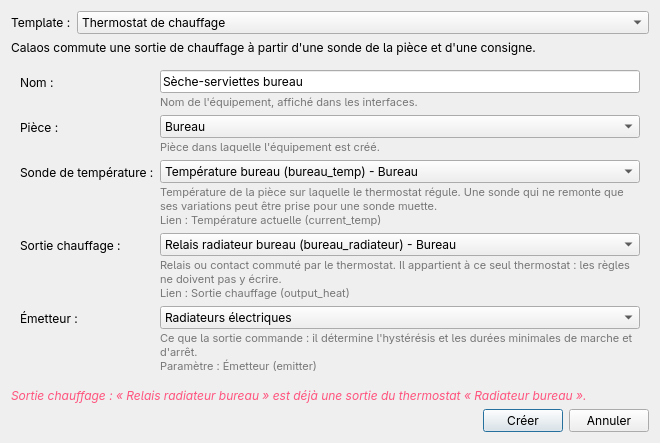 A relay already used by another thermostat is refused.
For multi-zone heating sharing a boiler, a circulator or a heat pump, create one output per zone (a valve or relay per thermostat), and rules that turn the common output on as soon as a zone output is on. See the examples in Heating rules.
Outputs are protected
The relays driven by a thermostat must not be written elsewhere. If a rule, a Lua script or a command writes one directly, the value is applied but a warning is logged: Calaos never blocks the rules engine. The thermostat then puts the output back to the wanted state after put_back_delay seconds (the delay doubles while the other writer keeps undoing it, up to put_back_delay_max), and logs every put-back as an error. The MCP assistant does not see these outputs and cannot write them.
To switch a thermostat off, write its mode (off), never its relay.
The thermostat in the interfaces
The displayed status combines the action (heating, cooling, idle), the minimum-time lock-out and the faults above: see Display and control.